



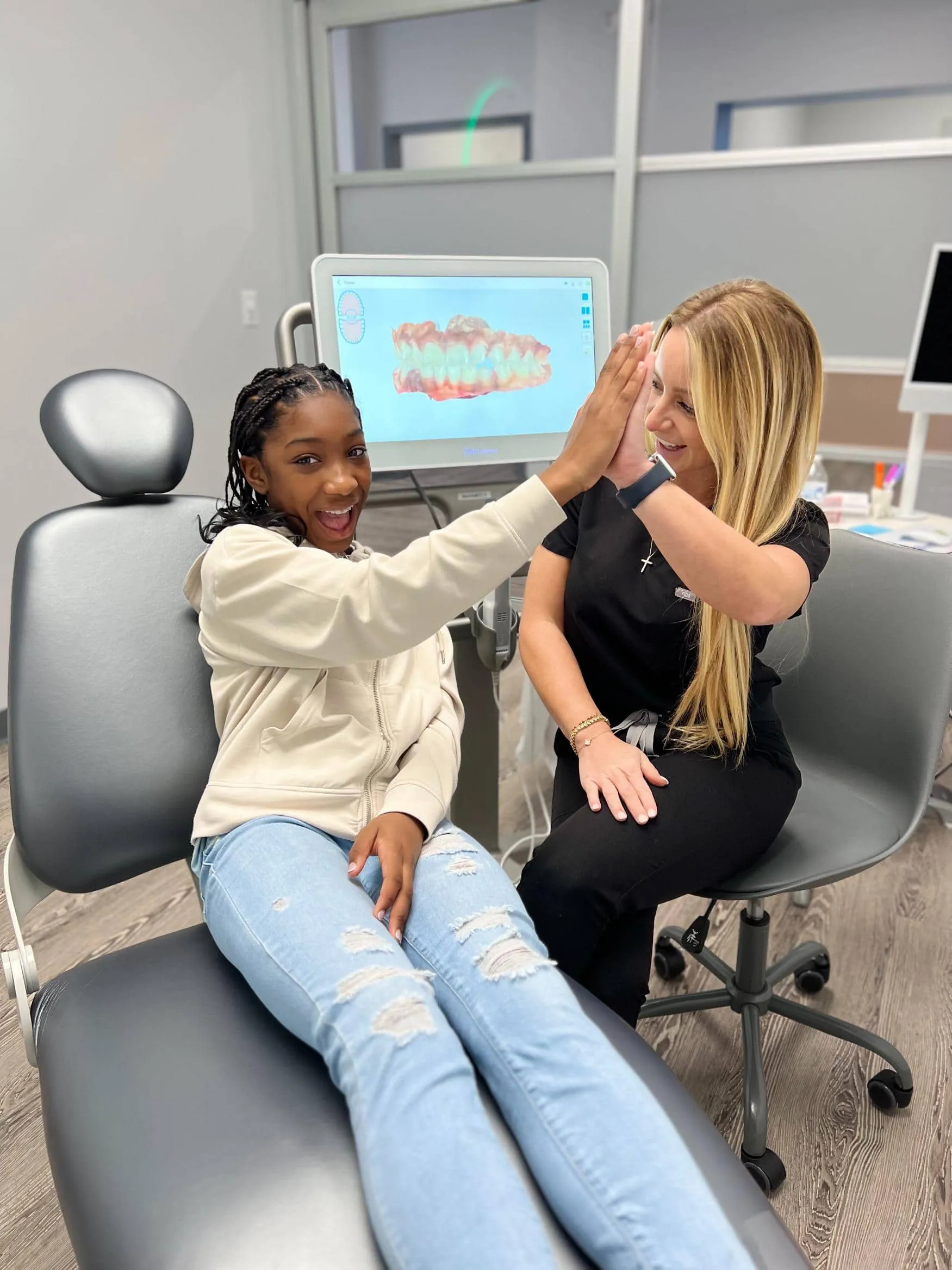
When your child needs orthodontic treatment, you want to make the right choice. Comparing Invisalign First vs braces for kids is one of the most common questions parents bring to a free consult. Both are effective options for young smiles, but they work differently and suit different needs. Here’s what we tell parents when they’re trying to pick one.
What Are Invisalign First and Traditional Braces for Kids?
Invisalign First is a clear aligner system designed for children ages 6 to 10 with mixed dentition. Traditional braces use fixed metal or ceramic brackets and archwires to move teeth. Both serve as Phase 1 treatment (early intervention) options, and board-certified orthodontists recommend either depending on the child’s specific needs.
Invisalign First
Invisalign First aligners are custom-made from smooth, BPA-free plastic and fit snugly over your child’s teeth. These kids typically have mixed dentition, meaning they still have some baby teeth while permanent teeth are coming in. Aligners are replaced every one to two weeks as teeth gradually shift into better positions.
Traditional Braces
Traditional braces use metal or ceramic brackets bonded directly to teeth, connected by archwires that apply gentle, consistent pressure. Metal braces remain the most widely used orthodontic appliance for children of all ages. They’re incredibly versatile and can address everything from minor spacing issues to complex bite corrections.
Either option can serve as Phase 1 treatment or full treatment depending on what your child needs. Phase 1 focuses on guiding jaw growth and creating space for permanent teeth, while full treatment addresses the alignment of all permanent teeth.
The key difference? Invisalign First aligners are removable. Your child takes them out to eat, brush, and floss. Braces stay in place 24/7 until treatment is complete. Our team offers both options and can help you determine which one is the better fit for your child’s smile.
How Each Treatment Works: The Process for Kids
Both treatments start the same way: a free consult with an orthodontist. During this visit, our team takes digital scans or impressions of your child’s teeth, examines their bite, and reviews X-rays to understand how their jaw is developing. From there, we create a custom treatment plan tailored to your child’s smile.
How Does the Invisalign First Process Work?
Your child receives a series of clear aligners, each slightly different from the last. They wear each set for one to two weeks, then switch to the next in the series. The aligners must be worn 20 to 22 hours per day to work properly. That means they only come out for meals and brushing.
Check-up visits happen every 6 to 10 weeks so we can monitor progress and provide the next sets of aligners. It’s a straightforward routine once your family gets the hang of it.
How Does the Braces Process Work?
With braces, brackets are bonded to your child’s teeth during the initial visit. An archwire connects the brackets and does the work of moving teeth. Adjustment visits happen every 4 to 8 weeks, where we tighten or change the wires to keep treatment progressing.
Treatment timelines for Phase 1 typically range from 6 to 18 months for both options. The biggest difference comes down to compliance. Invisalign First requires your child to remember to wear their aligners consistently. Braces work continuously without any effort from your child since they simply can’t forget to wear them. No reminders needed.
Our Confident Edge: Invisalign First and Braces for Kids
These treatment options each offer real advantages. The best choice depends on your child’s specific needs, personality, and lifestyle. Here’s a quick summary: Invisalign First gives kids a nearly invisible, removable option with easier oral hygiene, while traditional braces deliver reliable, round-the-clock tooth movement that works well for any case complexity.
What Are the Benefits of Invisalign First?
- Nearly invisible appearance, so most people won’t even notice your child is in treatment.
- No food restrictions whatsoever. Aligners come out for every meal and snack.
- Take aligners out and your child can brush and floss normally, no working around brackets required.
- The smooth, BPA-free plastic means no brackets or wires poking at cheeks and lips.
- Fewer emergency visits since there are no broken brackets to repair.
- Self-conscious kids often prefer the discreet look, which can be a real confidence boost during school and activities.
What Are the Benefits of Traditional Braces?
- They work around the clock automatically, no matter what. Zero compliance concerns.
- Braces handle severe crowding, rotations, and bite issues that aligners may struggle with.
- Durable enough to withstand rough play and sports, so active kids do great with them.
- Our orthodontists can make very specific, precise adjustments at each visit.
- Kids love choosing colorful bands at every adjustment, turning treatment into something they actually look forward to.
Both treatment options guide jaw growth effectively and create space for permanent teeth that haven’t erupted yet. The American Association of Orthodontists notes that early treatment can simplify or even prevent the need for more involved treatment later. That’s why the AAO recommends an initial evaluation by age 7.
Invisalign First vs Braces for Kids: Side-by-Side Comparison
Wondering how these two options stack up across the factors that matter most? The table below breaks it down. Keep in mind that every child’s situation is different, so what works perfectly for one family might not be the right call for another. Your orthodontist’s recommendation will always account for your child’s specific bite, dental development, and daily habits.
| Factor | Invisalign First | Traditional Braces |
|---|---|---|
| Visibility | Nearly invisible clear plastic | Visible metal or ceramic brackets |
| Removability | Removable for eating and cleaning | Fixed in place throughout treatment |
| Compliance Needed | High, must wear 20-22 hours daily | Low, works automatically |
| Food Restrictions | None | Avoid hard, sticky, and crunchy foods |
| Comfort | Smooth plastic, minimal irritation | May cause initial soreness, bracket irritation |
| Best For | Mild to moderate cases | Mild to severe cases, including complex bites |
| Emergency Visits | Less frequent | Possible for broken brackets or wires |
| Cleaning | Remove aligners, brush normally | Requires careful brushing around brackets |
| Sports | Remove for contact sports, wear mouthguard | Wear mouthguard over braces |
| Treatment Time | 6-18 months typical | 6-18 months typical |
Braces handle severe malocclusions and complex tooth movements better than aligners in many cases. Invisalign First excels for mild to moderate crowding, spacing issues, and certain bite corrections in compliant children.
When prescribed for the right candidate, each option delivers excellent results. That’s why a thorough evaluation matters so much. Our orthodontists assess your child’s specific situation and recommend the option most likely to achieve a great outcome. If you’re still on the fence after reading through this comparison, a free consult is the fastest way to get a clear answer.
Cost Factors: Invisalign First vs Braces for Kids
Invisalign First and traditional braces for kids typically fall within a similar price range. The final cost depends on case complexity, treatment duration, and geographic location. Many parents assume Invisalign First costs significantly more than braces, but pricing is often closer than you’d expect.
Several factors influence the final number:
- Case complexity. More involved cases require longer treatment and more materials.
- Treatment duration. A longer timeline generally means a higher overall cost.
- Geographic location. Costs vary by region and local market conditions.
- Provider experience. Board-certified orthodontists may charge differently than general dentists offering orthodontic services.
Insurance coverage for Invisalign First and braces is often comparable. Most orthodontic benefit plans cover both options up to the same lifetime maximum. Some plans have specific exclusions or waiting periods, so it’s worth reading the fine print. Check with your insurance provider for specifics about your plan.
We offer low monthly payment options to make either treatment work for your family’s budget. A free consult is the best way to get an accurate cost estimate based on your child’s actual needs. No surprises, just a clear breakdown of what to expect financially before you commit.
Is Your Child a Candidate for Invisalign First or Braces?
Children ages 6 to 10 with mild to moderate crowding and good compliance are typically ideal Invisalign First candidates. Braces suit any age and complexity level, especially for severe bite issues. Not every child qualifies for every treatment, so here’s how candidacy typically breaks down.
Who Is a Good Candidate for Invisalign First?
- Ages 6 to 10 with mixed dentition
- Mild to moderate crowding or spacing
- Certain bite issues like crossbites or minor overbites
- Responsible enough to wear aligners consistently, and parents willing to help monitor compliance
Who Is a Good Candidate for Traditional Braces?
- Any age from early childhood through teens, with any level of case complexity
- If your child tends to misplace things or might struggle with aligner compliance, braces are often the better call
- Cases requiring certain tooth movements that aligners can’t achieve
- Families who prefer a hands-off approach with no daily reminders needed
During a free consult, our orthodontists evaluate X-rays, examine dental development, and assess your child’s behavior readiness. We look at how many baby teeth remain, which permanent teeth have erupted, and how the jaw is growing. The AAO recommends children have their first orthodontic evaluation by age 7. This doesn’t mean treatment starts at 7. It means we can identify potential issues early and determine the ideal time to get started if treatment is needed.
Frequently Asked Questions About Invisalign First and Braces for Kids
Can a 7-year-old get Invisalign First?
Yes. Invisalign First is designed specifically for children ages 6 to 10 who have a mix of baby teeth and permanent teeth. A 7-year-old with appropriate dental development and the maturity to wear aligners consistently can be an excellent candidate. Our orthodontists can determine readiness during a free consult.
Is Invisalign First as effective as braces for kids?
For mild to moderate cases, Invisalign First and braces produce comparable results. Research shows Invisalign First effectively treats crowding, spacing, and certain bite issues in children. That said, braces may be more effective for complex cases requiring significant tooth movement or rotation. The right choice really depends on what’s going on in your child’s mouth.
How long does treatment take for kids?
Phase 1 treatment typically lasts 6 to 18 months for both Invisalign First and braces. The exact timeline depends on your child’s specific issues and how well they follow treatment guidelines. Our orthodontists provide a more accurate estimate after the initial evaluation.
Does my child need braces after Invisalign First?
Some children benefit from Phase 2 treatment once all permanent teeth have erupted, typically in their early teens. This isn’t unique to Invisalign First. Children who have Phase 1 braces may also need Phase 2 treatment later. Early treatment often makes Phase 2 shorter and simpler, which is one of the biggest reasons orthodontists recommend getting started sooner rather than later.
Will insurance cover Invisalign First?
Most orthodontic insurance plans cover Invisalign First similarly to traditional braces. Coverage depends on your specific plan’s orthodontic benefits. We recommend contacting your insurance provider or asking our team to verify your benefits during your free consult. Every plan is a little different, so it’s worth checking before you make a decision.
What happens if my child loses an Invisalign First aligner?
Contact your orthodontic practice right away. In most cases, we can provide a replacement aligner or have your child move to the next set in the series. This is one reason parental involvement matters with Invisalign First. Keeping track of aligners requires some supervision, especially for younger children. Still not sure which option is right for your kid? That’s exactly what the free consult is for. A board-certified orthodontist can assess your child’s needs and walk you through both options so you can feel confident about the next steps for your child’s smile.